In the selection of hydraulic hoses, the outer cover production process (wrapped cover and smooth cover) directly affects the durability, environmental adaptability and installation convenience of hoses. In the industry, products are selected according to working conditions and the characteristics of the two cover processes. This article systematically compares the differences in process principles, core performances and application scenarios, so as to provide technical reference for hydraulic hose selection.
I. Essential Differences Between Two Outer Cover Processes
The appearance difference between the two outer covers lies in the tube blank coating materials and coating technologies adopted in the production process, which is the core source of their performance differences.
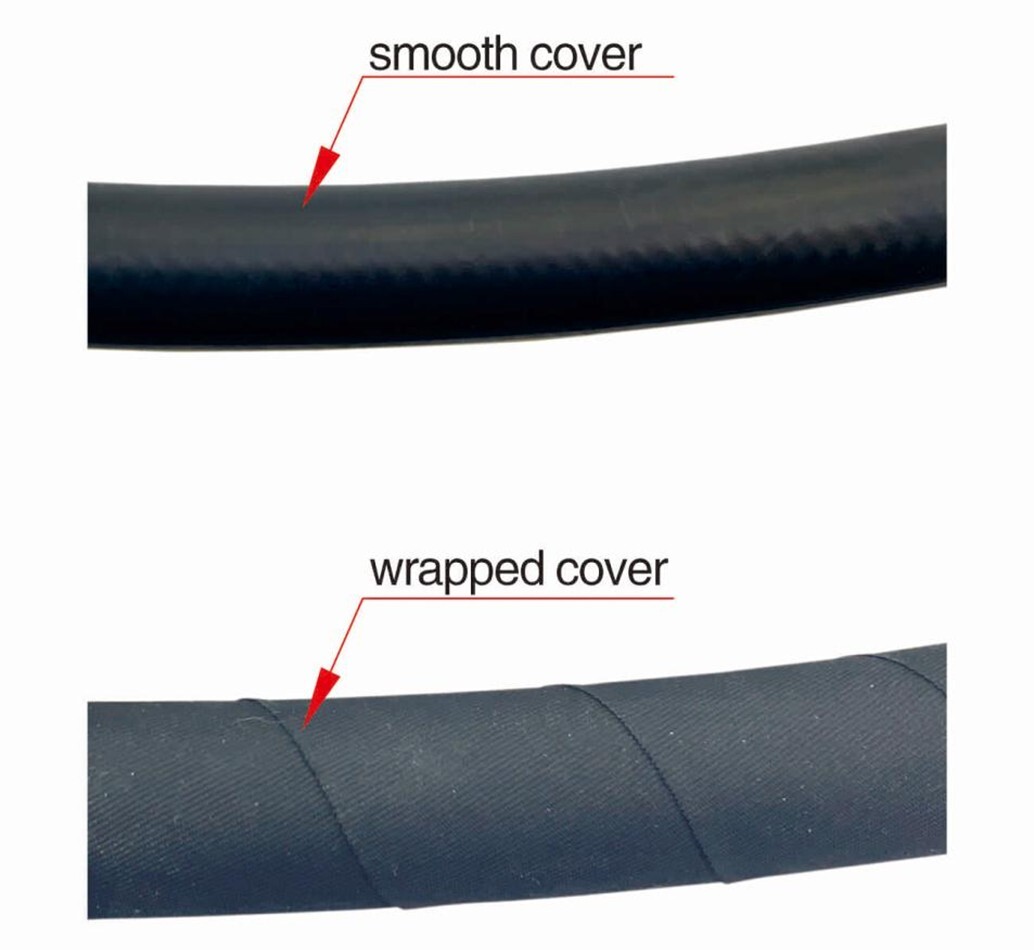
Wrapped Cover: Before vulcanization, soaked nylon fabric tape is spirally wrapped around the outer layer of the hose. During vulcanization, the fabric tape shrinks after heating and drying, applying uniform pressure to the hose body and making the outer rubber closely adhere to the hose skeleton. After vulcanization, the fabric tape is removed. The hose surface retains fabric textures and circular marks formed by the overlapping of woven tapes, presenting a cloth pattern appearance.
Smooth Cover: The extrusion process is adopted to evenly coat an integrated sheath on the outer layer of the tube blank, which provides uniform pressure for shaping during vulcanization. After vulcanization, the sheath is stripped off. The hose surface is flat without textures or indentations. It supports inline operation with outer rubber molding, delivering higher production efficiency.
II. Core Performance Comparison (Under the Same Material Condition)
1. Wear Resistance: Material Formula Is Dominant, Process Has Limited Impact
Wear resistance is mainly determined by the rubber formula of the outer cover rather than the vulcanization process. Actual test data proves that with identical materials, the two types show no obvious difference in wear resistance. The textured surface of wrapped cover hoses disperses local friction stress, while smooth cover hoses reduce abrasion resistance with a low friction coefficient. Both deliver stable wear performance under conventional working conditions.
2. Ozone Aging Resistance: Smooth Cover with Superior Performance
Ozone commonly exists around electrical equipment and welding areas. It corrodes rubber materials and causes surface cracking, which eventually leads to outer cover failure.
The wrapped cover outer cover features an uneven and undulating surface. Stress is easily concentrated on ridges and grooves, forming initial cracking points. Such hoses suffer faster aging in outdoor or high-ozone environments.
The smooth cover outer cover has a continuous flat surface without stress concentration, which can evenly resist ozone erosion. With the same material and service environment, it offers better ozone cracking resistance and longer service life.
3. Installation Adaptability: Smooth Cover Suits Complex Working Conditions
With annular ridges and rough surfaces, wrapped cover hoses are prone to scraping and hooking with equipment edges and adjacent pipelines in narrow and densely arranged piping spaces, resulting in difficult threading and potential component damage.
Smooth cover hoses have low surface friction, which can pass smoothly through narrow gaps and complex pipelines. They effectively avoid hooking problems, adapt to compact hydraulic system layout, and greatly reduce installation difficulty and hose damage risks.
4. Cleaning and Maintenance: Smooth Cover Is More Convenient
The texture grooves of wrapped cover outer covers easily accumulate dust, oil stains and impurities, bringing difficulties to daily cleaning. Long-term dirt accumulation will accelerate rubber aging.
Smooth cover hoses have seamless flat surfaces that are not easy to adhere to contaminants. Routine wiping is sufficient for maintenance with lower costs, making them highly suitable for precision machinery and other industries with high cleanliness requirements.
5. Special Application Adaptability: Wrapped Cover Is Irreplaceable
Although smooth cover hoses are applicable to most conventional scenarios, wrapped cover products possess unique and irreplaceable advantages:
- Compatible with special rubber compounds that cannot be coated by extrusion process, such as high oil-resistant and low-temperature-resistant rubber materials.
- Mature for manufacturing large-size and ultra-high-pressure hydraulic hoses to meet the demands of heavy machinery, mining equipment and other high-pressure working conditions.
- Flexible in production for small-batch and short-cycle customized orders with lower comprehensive costs.
III. Selection Suggestions for Different Working Conditions
Neither process is absolutely superior. The outer cover material formula is the core factor determining overall hose performance, while the production process acts only as an auxiliary factor.
| Working Condition | Recommended Outer Cover | Core Reason |
| Outdoor & high-ozone environment (Welding workshops, electrical equipment areas) | Smooth cover | Resist ozone aging, delay cracking and extend service life |
| Narrow space & dense pipeline layout (Construction machinery, precision equipment) | Smooth cover | Smooth surface for easy threading, anti-hooking and convenient installation |
| High-cleanliness required industries (Food, pharmaceutical, electronics) | Smooth cover | Easy to clean, no impurity residue, suitable for clean environments |
| Large-size & ultra-high-pressure conditions (Mining, metallurgy, heavy machinery) | Wrapped cover | Compatible with special rubber materials and large-size specifications with strong high-pressure stability |
| Small-batch customized orders | Wrapped cover | Flexible production, short delivery time and lower customization cost |
| Flexible production, short delivery time and lower customization cost | Wrapped cover | High cost performance, meeting basic wear and protection requirements |
IV. Conclusion
Wrapped cover and smooth cover hydraulic hose outer covers are two mature process solutions for differentiated production and application needs. The smooth cover features excellent aging resistance, easy installation and simple maintenance, covering most conventional and high-standard application scenarios. The wrapped cover highlights special material compatibility, large-size production capacity and efficient customization, filling the market demand for special working conditions.
During model selection, priority should be given to confirming the outer cover material parameters such as wear resistance and ozone resistance grade. Combined with actual working environment, installation space, specification requirements and budget, users can select the appropriate outer cover, so as to realize efficient, safe and long-term operation of hydraulic hoses.